Rolle's Mean Value Theorem
In calculus, there exists a theorem that guarantees the existence of a point where the slope of the tangent is zero if a function starts and ends at the same value on an interval. This result is known as Rolle’s Theorem. It is one of the core theorems in differential calculus.
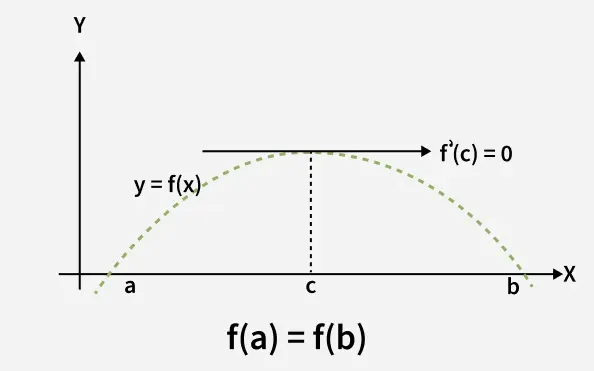
Formula used for Rolle's Theorem:
Statement
A function is defined in the closed interval in such a way that it satisfies the following condition:
- is continuous in the closed interval
- is differentiable in the open interval
- Then, there exists at least one point in the open interval such that:
Geometric Interpretation of Rolle’s Theorem
We can visualize Rolle's theorem from the figure(1) added below,
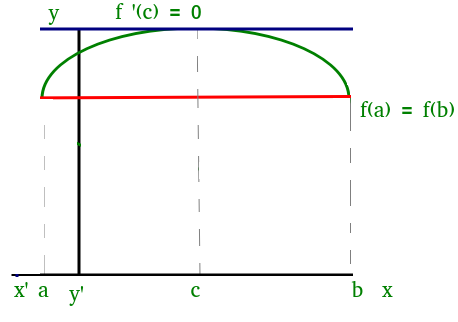
In the above figure the function satisfies all three conditions given above. So, we can apply Rolle's theorem, according to which there exists at least one point such that:
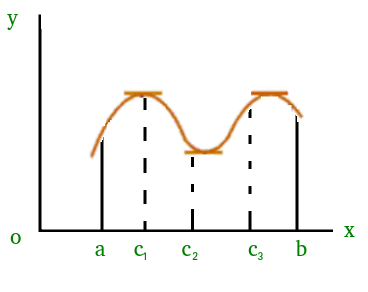
which means that there exists a point at which the slope of the tangent at that is equal to 0. We can easily see that at point slope is 0. Similarly, there could be more than one points at which slope of tangent at those points will be 0. Figure(2) added below is one of the example where exists more than one point satisfying Rolle's theorem.
Proof of Rolle's Mean Value Theorem
Consider a function that satisfies the conditions of Rolle's Theorem:
Since is continuous on and differentiable on by the Extreme Value Theorem, attains its maximum and minimum values on . If the maximum or minimum value is attained at some point in , then since the tangent line at is horizontal. If the maximum and minimum values are attained at the endpoints or , then is constant on and for all in .
Therefore, there exists at least one point in such that .
Related Articles:
- Mean Value Theorem
- Rolle's Theorem and Lagrange's Mean Value Theorem
- Lagrange's Mean Value Theorem
- Rolle’s Mean Value Theorem
Applications of Rolle's Mean Value Theorem in CS
Various applications of Rolle's Mean Value theorem in CS field:
- Algorithm Correctness: In analyzing functions used in algorithms, Rolle’s theorem guarantees the existence of critical points (where derivative = 0), important in optimization and proving algorithm stability.
- Signal Processing: When signals start and end at the same value, Rolle’s theorem ensures that somewhere in between the rate of change of the signal is zero (flat point), useful in compression and smoothing.
- Computer Graphics & Animation: While designing curves that begin and end at the same height, Rolle’s theorem ensures there will be at least one point of horizontal tangent, useful for smooth rendering.
Solved Examples on Rolle's Theorem
Example 1: Verify Rolle’s theorem for function , and .
Solution: Given function , as it is a polynomial function, is continuous in and differentiable in . Also,
Thus,
Hence, the function satisfies all conditions of Rolle's theorem.
Now,
Rolle’s theorem states that there is a point such that
Example 2: Verify Rolle’s theorem for function , and .
Solution:
Given function , as it is a polynomial function, is continuous in and differentiable in . Also,
Thus,
Hence, Rolle's theorem is not applicable.
Example 3: Verify Rolle's theorem for , and
Solution:
is a polynomial, so it's continuous on and differentiable on .
Thus,
Hence, Rolle's theorem is not applicable.
Example 4: Verify Rolle's theorem for , and
Solution:
is a polynomial, so it's continuous on and differentiable on .
Thus,
Rolle's theorem is applicable. ( where )
Example 5: Verify Rolle's theorem for , and
Solution:
is continuous on , but not differentiable at
Thus,
However, is not differentiable on the entire open interval .
Hence, Rolle's theorem is not applicable.
Example 6: Verify Rolle's theorem for , and .
Solution:
is continuous and differentiable everywhere.
Thus,
Hence, Rolle's theorem is not applicable.
Example 7: Verify Rolle's theorem for , and
Solution:
is continuous and differentiable everywhere.
Thus,
Rolle's theorem is applicable. ( where )
Example 8: Verify Rolle's theorem for , and
Solution:
is a polynomial, so it's continuous on and differentiable on
Thus,
Rolle's theorem is applicable. ( where )
Example 9: Verify Rolle's theorem for , and
Solution:
is continuous and differentiable for , so it's continuous on and differentiable on
Thus,
Hence, Rolle's theorem is not applicable.
Example 10: Verify Rolle's theorem for , and
Solution:
is continuous and differentiable everywhere.
Thus,
Rolle's theorem is applicable. ( where )
Practice Problems on Rolle's Mean Value Theorem
Question 1: Verify Rolle's theorem for on the interval
Question 2: Check if Rolle's theorem applies to on
Question 3: Determine whether Rolle's theorem can be applied to on
Question 4: Verify Rolle's theorem for on
Question 5: Examine if Rolle's theorem is applicable for on
Question 6: Check the applicability of Rolle's theorem for on
Question 7: Verify if Rolle's theorem can be applied to on
Question 8: Determine if Rolle's theorem holds for on
Question 9: Check whether Rolle's theorem is applicable to on
Question 10: Verify if Rolle's theorem can be applied to on