Biological Classification
Notes for NCERT Class 11 Chapter 2 Biological Classification: Biological classification is the process by which biologists group living organisms which, are classified on the basis of their similarity. Classification is essential for the convenient study of living organisms. It is required to identify different varieties of organisms. It helps in the correct identification of many organisms. It leads to the evolution of organisms. It also establishes phylogenetic relationships among organisms. Carolus Linneuas was one of the scientists to classify organisms.
NCERT Class 11 Biology Chapter 02 Biological Classification: The practice of classifying organisms based on shared characteristics is known as biological classification. Linnaeus proposed two areas of classification. He divided organisms into two kingdoms: the animal kingdom (Animalia) and the plant kingdom (Plantae). The classification of the two kingdoms had some disadvantages, such as the impossibility of distinguishing between eukaryotes and prokaryotes, unicellular and multicellular species, and photosynthetic and non-photosynthetic organisms. As a result, the field continued to grow and served as a primary example of R.H. Whittaker's classification of the five domains or kingdoms.
Biological Classification
Two Kingdom Classification
Two kingdom classification was given by a biologist, Carolus Linnaeus. He classified organisms into two kingdoms, i.e. Plantae (included all plants) and Animalia (included all animals).
Disadvantages of Two Kingdom Classification: This system didn't distinguish between the following types of organisms:
- Eukaryotes and prokaryotes
- Unicellular and multicellular organisms
- Photosynthetic (green algae) and non-photosynthetic (fungi) organisms
Five Kingdom Classification
In 1969, R.H. Whittaker proposed the five-kingdom classification. He classified those five kingdoms as Monera, Protista, Fungi, Plantae, and Animalia. He primarily used the following criteria for classification:
- Cell structure
- Body organisation
- Mode of nourishment
- Reproduction
- Phylogenetic linkages or relationships

Kingdom Monera
Bacteria are the main members of this kingdom. Kingdom Monera is further divided into:
- Archaebacteria
- Eubacteria or true bacteria

Archaebacteria
They are special bacteria as they can withstand extreme environmental conditions because of their different cell wall structure. They can be:
- Thermoacidophiles: They are found in the hot springs
- Halophiles: They are found in the salty areas
- Methanogens: They are found in the marshy areas/ gut of ruminant animals (production of biogas)
Eubacteria or True Bacteria
They have rigid cell walls and flagellum (locomotion), if motile. They can be photosynthetic autotrophs, chemosynthetic autotrophs and heterotrophs.
- Photosynthetic Autotrophs: Cyanobacteria (blue-green algae, have chlorophyll a), Nostoc and Anabaena are their common examples. They fix atmospheric nitrogen in specialised cells called heterocysts.
- Chemosynthetic Autotrophs: These oxidise inorganic substances (nitrates, nitrites, ammonia) and use the released energy for ATP production.
- Heterotrophs: They are decomposers. Some are pathogens, others are beneficial (making curd, producing antibiotics).

Reproduction in Bacteria
They reproduce by binary fission (asexual), transfer of DNA (sexual), and spore formation.

Mycoplasma
The smallest organisms which lack cell walls. They can survive without oxygen and are often pathogenic.
Kingdom Protista
Single-celled eukaryotes.
| Classification of Protista | Characteristic Features | Examples |
|---|---|---|
| Chrysophytes | Cell walls embedded with silica; form ‘diatomaceous earth’. | Diatoms and golden algae |
| Dinoflagellates | Cause 'red tides' (bioluminescence); release toxins. | Gonyaulax |
| Euglenoids | Have a flexible pellicle layer. | Euglena |
| Slime Moulds | Form plasmodium; produce spores in fruiting bodies. | Acrasia |
| Protozoans | Heterotrophs (predators/parasites). | Plasmodium |
Types of Protozoans
| Protozoans | Features/Diseases Caused | Examples |
|---|---|---|
| Amoeboid | Use pseudopodia to capture prey. | Amoeba |
| Flagellated | Cause sleeping sickness. | Trypanosoma |
| Ciliated | Use cilia for locomotion; have a gullet. | Paramoecium |
| Sporozoans | Cause diseases like malaria. | Plasmodium |
Kingdom Fungi
Multicellular heterotrophs (saprophytes/parasites).

Major Groups of Fungi
| Classification | Features | Examples |
|---|---|---|
| Phycomycetes | Found on decaying wood/moist sites. | Mucor, Rhizopus |
| Ascomycetes | Sac-fungi; used in biochemical work. | Penicillium, Yeast |
| Basidiomycetes | Includes mushrooms and puffballs. | Agaricus, Puccinia |
| Deuteromycetes | Imperfect fungi; decomposers of litter. | Alternaria |
Reproduction in Fungi
- Vegetative: Fragmentation, fission, budding.
- Asexual: Conidia, sporangiospores, zoospores.
- Sexual: Oospores, ascospores, basidiospores.
Kingdom Plantae
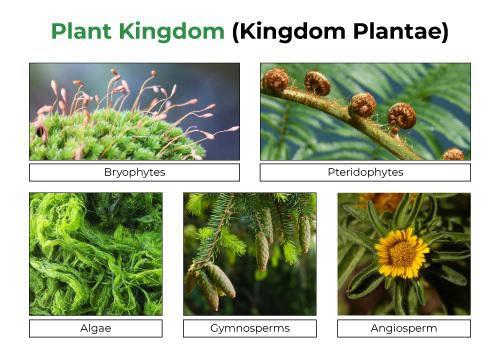
Multicellular eukaryotes with chlorophyll. Includes Algae, bryophytes, pteridophytes, gymnosperms, and angiosperms.
Kingdom Animalia
Multicellular heterotrophs; lack cell walls. Most show locomotion and produce an embryo during sexual reproduction.
Viruses, Viroids, Prions and Lichens
| Viruses | Viroids | Prions |
|---|---|---|
| DNA or RNA with protein coat. | Only RNA; no protein coat. | Only protein; no DNA/RNA. |
Bacteriophage
Viruses that infect bacteria.

Tobacco Mosaic Virus (TMV)
Infects tobacco plants; causes mosaic appearance on leaves.

Lichens
Symbiotic association between algae (phycobiont) and fungi (mycobiont). They are sensitive to pollution.