Kingdom Protista
Protists are primarily unicellular eukaryotes and are considered an important evolutionary link between plants, animals, and fungi.
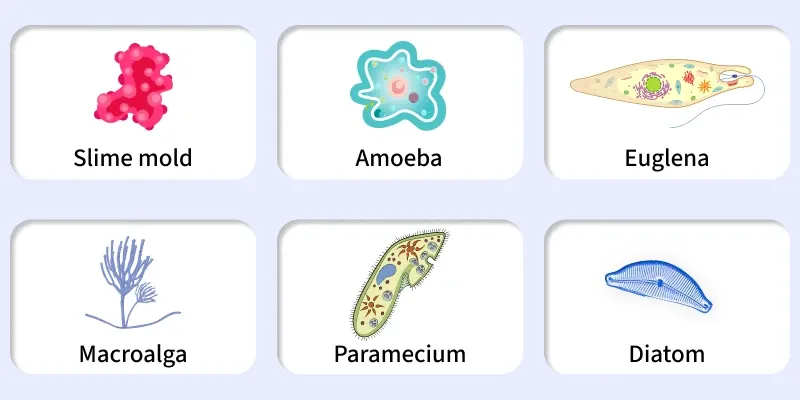
Characteristics of Protista
- Eukaryotic cells: Cells contain a nucleus and membrane-bound organelles like mitochondria.
- Cellularity: Mostly unicellular; some, like kelp, are multicellular but lack specialized organs.
- Locomotion: Use Flagella and Cilia or Pseudopodia.
- Nutrition: Autotrophic (algae) or heterotrophic (protozoa).
- Reproduction: Primarily asexual; sexual reproduction occurs under stress.
- Habitat: Aquatic (freshwater/marine) or moist soil.
Classification of Protista
- Protozoans: Heterotrophic relatives of animals (e.g., Amoeba, Paramecium).
- Slime Mould: Saprophytic decomposers that feed on decaying organic matter.
- Chrysophytes: Includes diatoms with silica-embedded walls and golden algae.
- Dinoflagellates: Predominantly marine photosynthetic protists.
- Euglenoids: Flexible freshwater protists like Euglena.
Economic Importance
- Foundational base of aquatic food chains.
- Enhance soil fertility through organic decomposition.
- Major source of oxygen and potential biofuel.
- Essential food source for large marine animals like whales.