Binomial Nomenclature
Binomial Nomenclature is a scientific system for naming living organisms using two words — the genus and the species. Introduced by Carl Linnaeus, it gives every organism a unique and universally accepted name to avoid confusion from common names.
All living organisms, including plants, animals, birds, and even microorganisms, have unique scientific names.
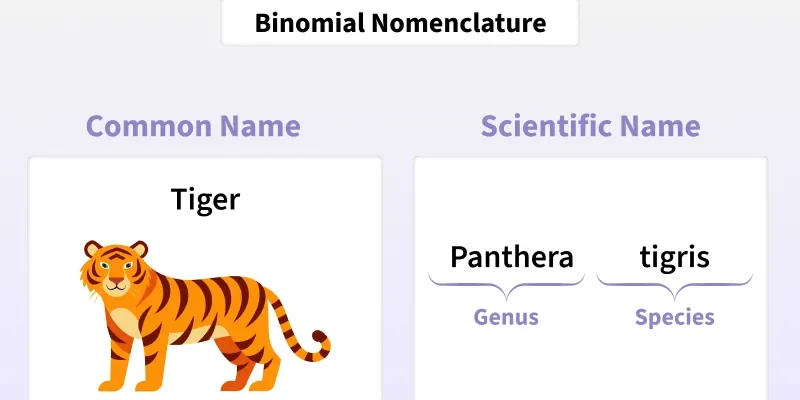
Examples
- The scientific name of a tiger is Panthera tigris, where Panthera denotes the genus and tigris specifies the species.
- The scientific name of humans is Homo sapiens, where Homo indicates the genus and sapiens refers to the species.
- The scientific name of the mango is Mangifera indica, where Mangifera indicates the genus and indica refers to the species.
Rules of Binomial Nomenclature
- Both codes make sure that each organism gets a specific name.
- Each scientific name has two parts: Generic name and Specific epithet.
- Scientific names are usually Latin and written in italics.
- The first word identifies the genus, the second identifies the species.
- Handwritten names are underlined; typed names are italicized.
- Genus starts with a capital letter, species with a small letter.
- ICBN: International Code of Botanical Nomenclature (plants).
- ICZN: International Code of Zoological Nomenclature (animals).
Importance
It provides a solution to the confusion caused by local common names throughout the world.
Drawbacks
- Law of priority: The first name used is correct, which can lead to synonyms.
- Names used before "Systema Naturae" (Linnaeus) are not recognized.